


At São Paulo Innovation Week 2026, marketing leaders from Amazon, Meta, and Mondelēz reached the same conclusion, albeit through different paths: data without interpretation is noise. And a brand without data is a gamble.
Led by the same organizers as Rio Innovation Week and by Estadão, the São Paulo Innovation Week It landed in the economic capital of Latin America, from May 13th to 15th, 2026, bringing together some of the leading names in innovation in Brazil and the world. The first edition took place in the iconic spaces of Mercado Livre Arena Pacaembu and FAAP (Fundação Armando Alvares Penteado), with stages and installations that connected 80,000 visitors and 1,877 speakers, including 160 international speakers, over the three days of the event.
In this edition, we follow the main discussions about the Building strong brands in the age of artificial intelligence.. From CMOs at big tech companies to global retailers, we hear how top leaders are considering the power of Brazilian identity, data, and innovation to drive their organizations' growth: from financial results to emotional connection with the consumer.
In this article, we will delve deeper into these conversations and support professionals, like you, who are seeking to answer the same question: How can I avoid the biggest silent risk to my brand's growth?
The invisible impact of misinterpreting data.
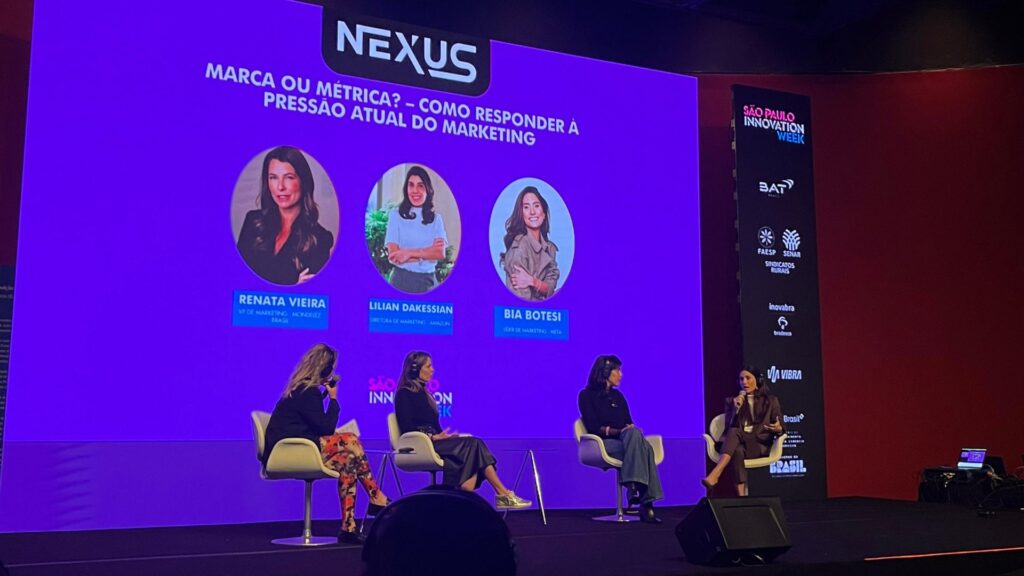
Mondelēz, Amazon e GoalThese three major brands were represented by their leaders Renata Vieira (VP of Marketing at Mondelēz), Lilian Dakessian (Director of Brand and Communication at Amazon), and Beatriz Bottesi (CMO at Meta) on the panel. “"Brand or Metric: How to Respond to Current Marketing Pressure"”. Three different industries, one vision: brand and metrics They are not opposites; they are two assets that work together to build strong brands..
As the speed of data increases, leaders feel more pressured to make decisions with agility and precision. As AI drives efficiency and scale, metrics become fragmented from online to offline, from the top to the bottom of the funnel. It is in this scenario that... branding and marketing professionals They increasingly need to orchestrate decisions with actions that strengthen the brand's bond with the consumer. After all, actions driven solely by short-term performance can often..., dilute the brand value e to weaken its reputation and relevance..
Leaders who make decisions without branding data Effective managers who rely solely on internal perception, campaign history, or intuition are, in practice, managing one of their main assets in the dark. They know the brand exists, but they don't know if it's growing, much less if it's connecting emotionally with its consumers. Lilian Dakessian, Amazon Brand and Communications Director, He put that tension precisely: efficiency, for Amazon, isn't a budget spreadsheet. It's the question asked before every decision: “"Does this matter to the customer?"”.
With increasing volumes of information (media metrics, performance data, platform reports), it has become clear that the challenge is not a lack of data. What is almost always lacking is the interpretation of what the data reveals about the brand's evolution in the minds and hearts of those who decide to buy. When the answer is not supported by... tangible branding data, Efficiency becomes an incomplete calculation. After all, being present is one thing. Knowing what that presence is building in the perception of those who matter is quite another.
What data really matters to the brand?
On the same panel, Renata Vieira, VP of Marketing at Mondelēz I gave an example that illustrates well the difference between presence and relevance: Lacta reaches 1.2 million points of sale in a country with 3 million. Knowing this is important. But more important is understanding the frequency of consumption, the emotional association, and the position the brand occupies in people's lives beyond the shelves.
This is the central point when talking about brand metricsIt's not just about measuring presence, but about measuring the value it generates. The questions the data needs to answer go beyond reach and engagement. What matters is: is the brand merely being seen, or is it being chosen? Beatriz Bottesi, Meta CMO, He went straight to the point: “"Reach generates visibility, but visibility is not the same as choice.". And for the brand to be chosen, it reinforces the importance of personalization: evaluating the wealth of information available about the consumer, seeing them as an individual with a name and a tax identification number, and transforming these insights into unique shopping experiences that only digital can provide.
A online advertising It captures attention and, without a doubt, it's one of the biggest drivers for brands to build grand campaigns. But as Beatriz points out: it's important Balancing attention with segmentation and high affinity at the same time.. Being present without being intrusive. And it's the combined metrics that can provide a clearer understanding of consumer behavior and the brand's relevance in their lives.
The risk of intuitive decisions
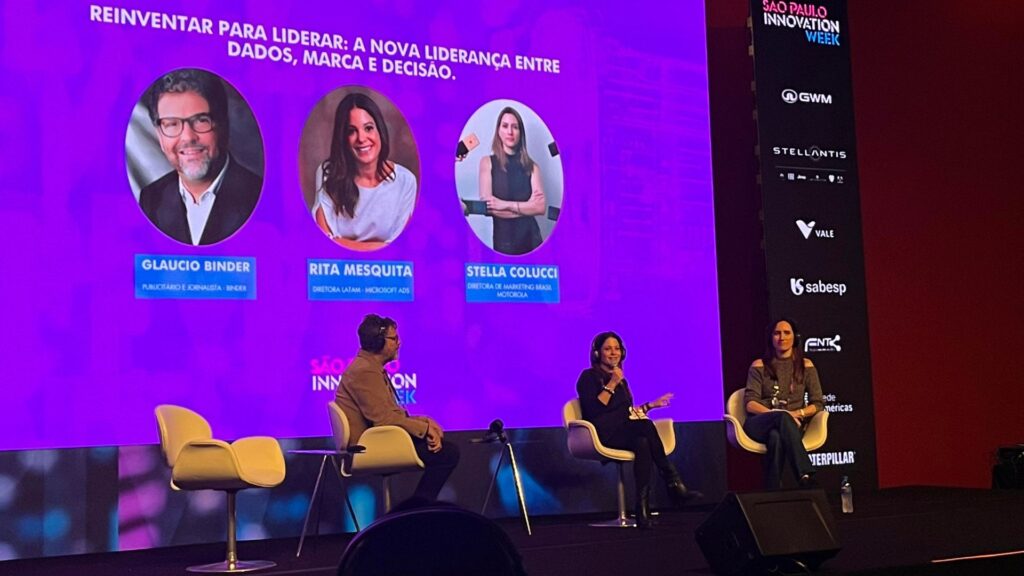
On the panel “"Reinventing to lead: the new leadership between data, brand and decision-making"”, a Motorola Marketing Director, Stella Colucci, The event brought up an important provocation: data and reports are always looking to the past. How can we use this to make decisions for the future? The question reveals a paradox among today's leaders: those who make decisions based on intuition and those who remain stuck in past data. Both situations tend to lead decisions to the same place: brand, business, and communication operating in a way that is disconnected from... organizational ambition.
In this conversation, Rita Mesquita, Latam Director of Microsoft Ads reinforced: “"Data is important, but the power of data lies in knowing how to use it for your strategy, to improve your brand and positioning."”. From product launches to communication plans, data needs to guide the strategy and, moreover, be consolidated into an integrated vision across BI teams, marketing, leadership, and agencies.
Furthermore, one of the most frequently mentioned words in the panel was... consistency. “"In a world increasingly concerned with short-term results, consistency will never cease to be relevant."”, "That's what Stella said. She further emphasized that tactics can change all the time and that teams need to be able and agile to adapt to them. But the organization's purpose, strategy, vision, and brand narrative must be consistent across all touchpoints: from organizational culture to advertising campaigns.".
And perhaps that is the greatest drawback that intuitive decisions often bring: without a solid foundation of branding, data and business vision, However, brands can put their reputation and relevance at risk at any time, failing to grow in a structured way and losing ground to the competition.
Branding that isn't measured can't be managed.
At the close of the panel “"Brand or metric"”, no São Paulo Innovation Week, The phrase that remained was... Lilian Dakessian, from the Amazon: “"Raw intelligence will become a commodity."” She emphasizes that what will differentiate organizations in the coming years is insight: the ability to transform data into decisions with empathy, speed, and strategy.
For organizations, this has a direct implication: it's not enough to have access to data. They need the right system to interpret it and the discipline to use it to manage branding as the strategic asset that it is. Branding metrics These are not just a campaign end report. They are the compass that guides sustainable growth.
Organizations that still decide on positioning, investment, and communication without this compass are not only running an operational risk. They are failing to consciously and measurably build the asset that most differentiates brands that grow from those that merely appear.
Valometry®: Making branding tangible for business.
In anacoute, We operate with a specific front of branding measurement solutions: the Valometry®. Developed by Ana Couto, founder and CEO of anacouto, the solution was created for organizations facing this challenge: they need To make the value of branding tangible and defensible. within their organizations. Using a proprietary methodology, branding is measured in three dimensions called Value Waves: Product, People, and Purpose and the Branding Value Score (BVS), an indicator that allows you to track the evolution of a brand over time, compare it with the competition, and understand, with precision, whether the attention a brand generates translates into a positive and relevant impact for the consumer.
By combining metrics selected according to each client's challenge, such as quantitative and qualitative research, social listening, and brand tracking, the Valometry® It is capable of generating actionable insights into brand, business, and communication, making the value of branding tangible in each of these areas of the organization. Because it's not just isolated attention that reveals brand value. When this distinction is made clearly, it has the power to unlock the organization's true value.
anacouto: We drive the value of people and organizations.
For more than three decades, the Anacouto agency It exists because it believes that branding drives the value of people and organizations. Founded by designer Ana Couto, the agency is a benchmark in branding and communication in Brazil and acts as a strategic partner for brands such as Itaú, Natura, CBF, Brastemp and Havaianas. With a proprietary methodology that integrates what the organization IS, what it DOES, and what it SAYS—connecting brand, business, experience, and communication based on corporate strategy—anacouto has already accelerated more than 400 organizations and won more than 50 national and international awards. In our ecosystem, we work with... Valometry®, proprietary consulting firm data-driven brand management which transforms brand perception into business intelligence. For us, branding is not just about brand strategy. Branding is about managing the organization's value.

